
Photo courtesy of Evolve Business Intelligence
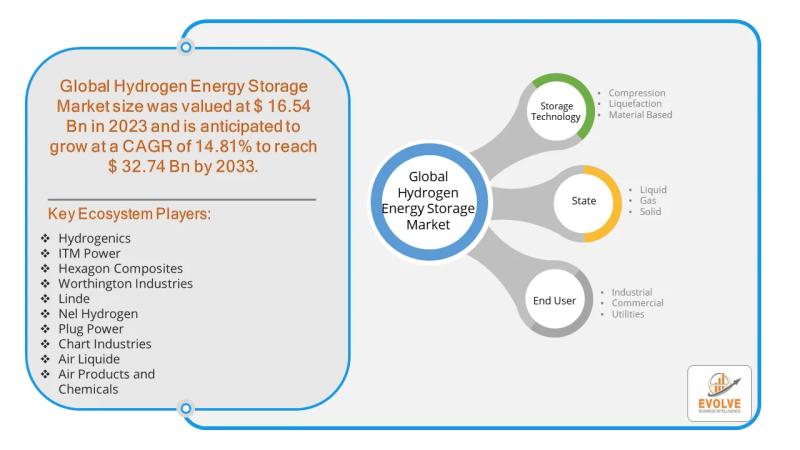
The global energy transition is accelerating, with hydrogen emerging as a key player in the decarbonization of various sectors. The Hydrogen Energy Storage Market, valued at USD 16.54 billion in 2023, is projected to reach USD 32.74 billion by 2033, expanding at a robust compound annual growth rate (CAGR) of 14.81%. Within this dynamic market, liquefaction presents a significant opportunity, offering a high-density, long-distance solution for hydrogen storage and transport.
Problems Faced by the Hydrogen Market
Despite its potential, the hydrogen market faces several challenges. The high cost of producing, storing, and distributing hydrogen, particularly green hydrogen, is a major barrier. The lack of an established infrastructure for hydrogen is another significant restraint, alongside the inherent inefficiency of converting energy to hydrogen and back to electricity.
The Liquefaction Solution
Liquefaction involves cooling hydrogen gas to extremely low temperatures (-253°C or -423°F) to transform it into a liquid state. This process addresses the primary challenges of hydrogen storage by enabling higher energy densities than compressed gas, making it ideal for the transport of large volumes over long distances. The liquefied hydrogen storage market is projected to reach USD 7.8 billion by 2035, with a CAGR of 9.7% from 2025. This growth is driven by the increasing need for efficient storage in sectors like transportation and industrial processes.
Liquefaction’s role is critical in:
• Long-Distance Transport: Liquefied hydrogen is a practical solution for shipping hydrogen from production hubs to demand centers, similar to how liquefied natural gas (LNG) is transported.
• Large-Scale Storage: It facilitates the establishment of large-capacity storage facilities and refueling stations, which are essential for enabling widespread adoption of hydrogen fuel.
• Stationary Applications: Liquid hydrogen can be used to store excess renewable energy from solar and wind, providing a long-duration energy storage solution for grid stabilization that batteries cannot easily fulfill.